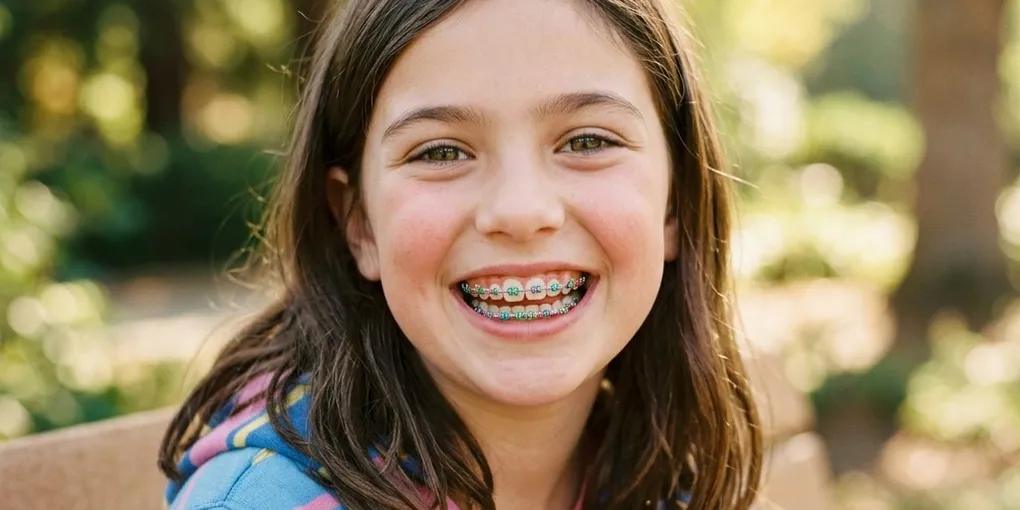
The Golden Period for Kids Braces: When Should Your Child See an Orthodontist?
Disclaimer: The information provided in this article is for educational purposes only and does not substitute for professional medical or dental advice. Always consult with a qualified dentist regarding your specific condition.
As a parent, you watch your child grow and change every day. But when it comes to their teeth and jaw development, it can be hard to know exactly what is “normal” and what might require professional intervention.
One of the most common questions we hear at Canary Dental Clinic in Surrey is: “At what age should my child get braces?”
While every child develops at their own pace, there is a recognized “golden period” for orthodontic evaluation. Understanding this timeline can save your child from more invasive dental procedures down the road.
The Age 7 Rule: The First Orthodontic Check-Up
The Canadian Association of Orthodontists recommends that children have their first orthodontic evaluation by age 7.
Why age 7? By this age, most children have a mix of baby (primary) teeth and adult (permanent) teeth. Their jaw is still growing, and their first adult molars have usually erupted. This allows the dentist to evaluate the developing bite (how the upper and lower teeth meet) and spot any potential issues before they become severe problems.
Does a check-up at age 7 mean they will get braces immediately? Usually, no. For most children, this initial visit is simply an observation. The dentist will monitor their growth periodically until the time is right to begin treatment.
What is Phase 1 Orthodontics (Interceptive Treatment)?
If your dentist does spot a significant issue during that early evaluation, they may recommend Phase 1 Orthodontics, also known as interceptive treatment. This typically occurs between the ages of 7 and 10.
The goal of Phase 1 is not to achieve perfectly straight teeth—it is to guide jaw growth and create adequate space for incoming permanent teeth.
Common reasons for Phase 1 treatment include:
- Severe Crossbites: When the upper teeth sit inside the lower teeth.
- Underbites or Overbites: Extreme jaw misalignments.
- Severe Crowding: Creating space in the jaw so adult teeth don’t become impacted.
- Harmful Oral Habits: Correcting habits like thumb sucking or tongue thrusting that can warp the shape of the jaw.
Interceptive treatment often uses tools like palatal expanders, space maintainers, or partial braces. By fixing these structural issues early while the jaw bones are still soft and pliable, you can often prevent the need for adult teeth extraction or jaw surgery later in life.
The Traditional “Golden Period” for Braces (Phase 2)
If your child did not need Phase 1 treatment, or if they have completed it, the actual “golden period” for comprehensive braces (Phase 2) is usually between the ages of 11 and 14.
During this window:
- Most Adult Teeth Are In: Almost all of their permanent teeth have erupted.
- Growth Spurts: Children are going through major growth spurts, making it the ideal time for the orthodontist to harness that natural growth to move teeth and align the jaw efficiently.
- Social Norms: It is very common for kids in middle school to wear braces, making the social adjustment much easier.
Signs Your Child Might Need to See an Orthodontist
Even if your child is not quite 7, you should schedule a consultation if you notice any of the following:
- Early or late loss of baby teeth.
- Difficulty chewing or biting into food.
- Mouth breathing.
- Prolonged thumb or finger sucking.
- Teeth that are visibly crowded, misplaced, or blocked out.
- Jaws that shift, make sounds, or seem out of proportion to the rest of the face.
Book Your Child’s Evaluation in Surrey
Early detection is the key to a lifetime of healthy, beautiful smiles. If your child is approaching age 7, or if you have any concerns about their dental development, don’t wait.
Our bilingual team (English and Mandarin) at Canary Dental Clinic in Surrey is experienced in pediatric dental care and early orthodontic intervention.